2026 Theme: “Where Young Minds Shape Tomorrow”

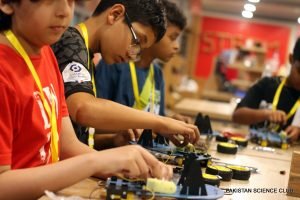
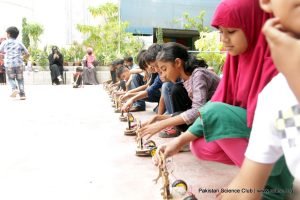
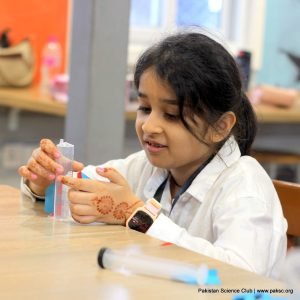
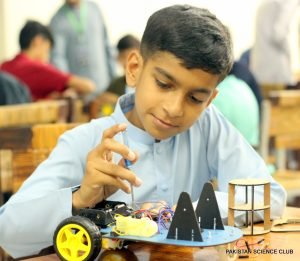
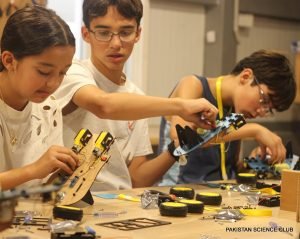
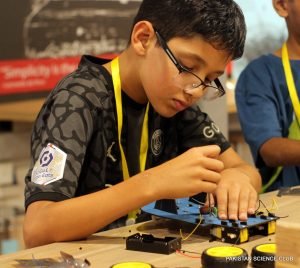
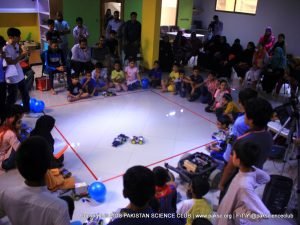
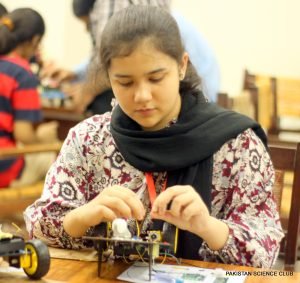
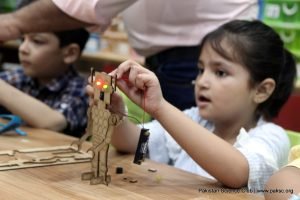
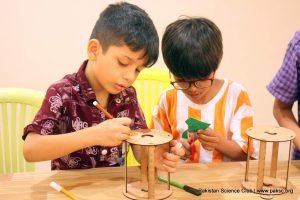
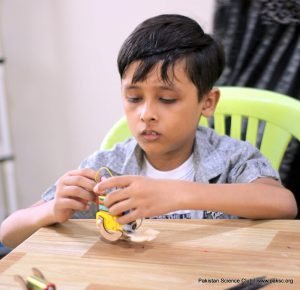
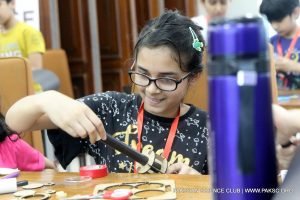
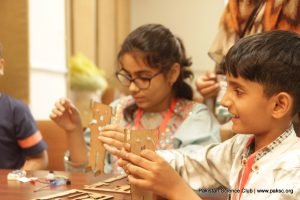
Pakistan Science Club (PSC), is hosting a STEM Summer camp in Karachi. The camp aims to provide an interactive learning experience for participants by engaging them in hands-on scientific activities. Through this camp, students will have the opportunity to explore various STEM fields, conduct experiments, and develop their problem-solving and critical-thinking skills.


STEM Camp 2026 schedule for PSC HQ Korangi Karachi

  • 📆 Duration: 4 Weeks (12 Days)
  • 📍 Schedule: 3 Days per Week
  • Session Length: 2 Hours per Day
  • 👩‍🔬 Age Groups & Timings
  • 🔹 Little Makers (Ages 7–9) — 🕙 10:00 AM – 12:00 PM
  • 🔹 Young Makers (Ages 10–12) — 🕙 10:00 AM – 12:00 PM
  • Teen Innovators Bootcamp (Ages 13–16) — 🕓 4:00 PM – 6:00 PM

Fee Discount

  • Minimum Registration: 2 Weeks
    • 2 Weeks: Rs. 6,000
    • Full Camp (4 Weeks): Rs. 10,000
      • Students must enroll for at least 2 weeks.
  • Sibling Discount: 10% discount
    Sibling Discount Policy:
  • A 10% discount will be applied to the second child’s fee when two children are enrolled.
  • If three children are enrolled, a 10% discount will be applied to the second and third child’s fees.
    Please Note:
  • The discount is not applicable to the first enrolled child.
  • No discount is offered if only one child is enrolled.
  • This is the only discount available; no additional discounts apply.

Complete the Online Application for Korangi


📅 Program Overview


🔹 Little Makers (Ages 7–9)

Young explorers discover science through fun experiments, creative building activities, and hands-on exploration. The program encourages curiosity and helps children understand how science works in everyday life.


🤖 Week 1 – Technology, Robotics & Electronics

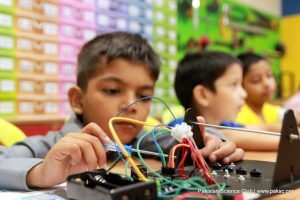
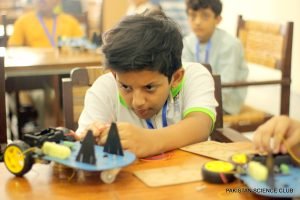
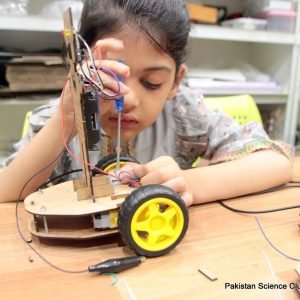
In this week, students are introduced to the basics of electricity, simple circuits, and moving machines. They explore how electrical energy can power lights, motors, and simple robotic systems.

Week 1 – Technology, Robotics & Electronics

Topics Covered

⚡ Introduction to electricity
⚡ Basic electrical circuits
⚙ Motors and motion
🤖 Simple robotics concepts

Skills Developed

Developing early engineering thinking

Understanding basic circuits

Exploring how motors create motion


🌱 Week 2 – Life Science Lab

This week focuses on the fascinating world of plants and the human body. Students learn how living systems work through observation and simple biological experiments.

🌱 Week 2 – Life Science Lab

Topics Covered

🌱 Plant growth and germination
💧 Soil-free plant growing techniques
🫁 Human body systems and organs

Skills Developed

Learning how living systems function

Understanding plant biology

Scientific observation


🌍 Week 3 – Earth & Space Science

Students explore our planet and the universe, learning about Earth, the Sun, the Moon, and the science of space observation.

🌍 Week 3 – Earth & Space Science

Topics Covered

🌎 Earth–Sun–Moon relationships
☀ Understanding sunlight and time
🔭 Introduction to telescopes and space observation
🦴 Fossils and Earth’s history

Skills Developed

Observational science

Basic astronomy concepts

Understanding planetary motion


🧭 Week 4 – Survival Science

In the final week, students learn practical science through real-world survival and environmental challenges.

Week 4 – Survival Science

Topics Covered

💧 Water purification and filtration
🧭 Navigation and directions
🏕 Outdoor survival principles

Skills Developed

Creative problem solving

Environmental awareness

Navigation and orientation


Young Makers (Ages 10–12)

Students in this group explore more advanced science and engineering concepts, building on their curiosity while developing stronger problem-solving and design skills.


🤖 Week 1 – Technology, Robotics & Electronics

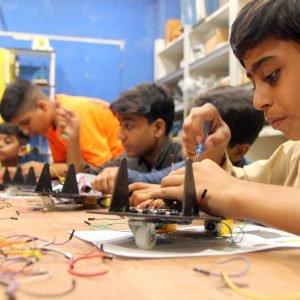
This week introduces students to the fundamentals of electronics, circuits, and robotic mechanisms.

Week 1 – Technology, Robotics & Electronics

Topics Covered

🔌 Basic electronic components and circuits
⚙ Mechanical systems and gears
🤖 Robotics principles and control

Skills Developed

Developing engineering problem-solving skills

Understanding electronic systems

Exploring robotics and automation


🌱 Week 2 – Life Science Lab

Students investigate the science of plants and the human body, connecting biology with engineering ideas.

🌱 Week 2 – Life Science Lab

Topics Covered

🌿 Photosynthesis and plant science
💧 Soil-free plant growing systems
🦾 Muscles, movement, and body mechanics

Skills Developed

Scientific investigation

Combining biology with engineering ideas

Design thinking


🌍 Week 3 – Earth & Space Science

This week focuses on astronomy, optics, and planetary science.

Little Makers (Ages 7–9)

Topics Covered

🔭 Principles of telescopes and optics
☀ Solar observation and solar science
🌑 Planetary motion and impact science

Skills Developed

Exploring astronomy concepts

Scientific measurement

Understanding optical systems


🧭 Week 4 – Survival Science

Students explore applied science and real-world problem solving through survival and environmental engineering concepts.

Topics Covered

💧 Water purification and filtration systems
🔥 Fire science and energy
🧭 Navigation and direction finding

Skills Developed

Critical thinking and teamwork

Practical science applications

Outdoor engineering concepts


Teen Innovators Bootcamp (Age 13–16)

This advanced program introduces students to engineering, electronics, digital fabrication, and innovation through hands-on learning in a makerspace environment. Students develop practical skills while learning how ideas can be transformed into working prototypes.


Week 1 – Maker Foundations

This phase introduces students to the maker mindset, where creativity, engineering, and practical skills come together to turn ideas into real objects.

Topics Covered

🔧 Introduction to innovation and the maker culture
🔧 Design thinking and problem-solving
🔧 Understanding the idea-to-prototype process
🔧 Basic engineering principles and mechanical systems
🔧 Safe use of tools and workshop equipment

Maker Skills

🪚 Basic woodworking and material handling
🛠 Measuring, cutting, drilling, and assembling parts
⚙ Understanding structures, motion, and simple mechanisms

Students begin working with tools and materials while learning how engineers design, build, and improve physical systems.


Week 2 – Electronics & Smart Devices

In this phase, students explore the fundamentals of electronics and smart systems.

Topics Covered

⚡ Basics of electricity
⚡ Voltage, current, and resistance
⚡ Electronic components and circuits
⚡ Breadboard prototyping
⚡ Logic and timing in electronic systems

Students gain practical experience working with LEDs, sensors, circuits, and basic electronic systems, helping them understand how modern electronic devices function.


Week 3 – Digital Fabrication

This phase introduces students to modern digital manufacturing technologies used in engineering and product development.

Topics Covered

✏ Introduction to vector design
✏ Basic CAD modeling
✏ Preparing designs for fabrication

Tools & Technologies

🖨 Laser cutting machines
🖨 3D printing technology
🖨 Digital design software such as Inkscape and TinkerCAD

Students learn how digital ideas are transformed into physical objects, gaining experience in the complete process from design to fabrication.


Week 4 – Innovation & Invention

In the final phase, students apply everything they have learned to develop an innovation project.

Innovation Process

💡 Identify a real-world problem
💡 Brainstorm possible solutions
💡 Design and build a prototype
💡 Test and improve the design
💡 Present the final project

Students work individually or in teams to develop functional prototypes using electronics, mechanical components, and digital fabrication tools.

This phase encourages creativity, engineering thinking, collaboration, and innovation.


STEM Summer Pack

If you cannot join Onsite Camps, checkout Pakistan Science Club’s SciecneStore.pk STEM Summer Pack

Made in Pakistan